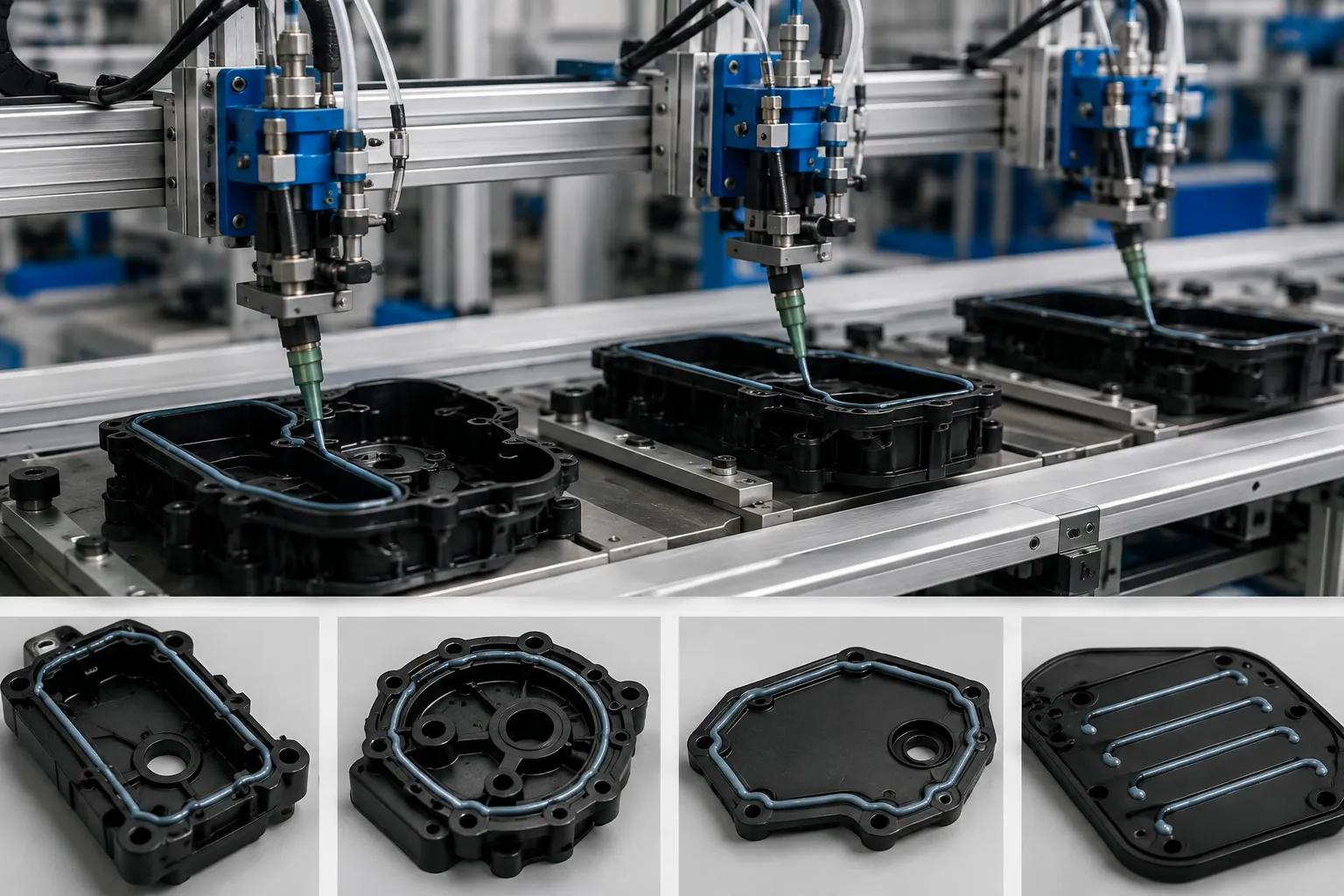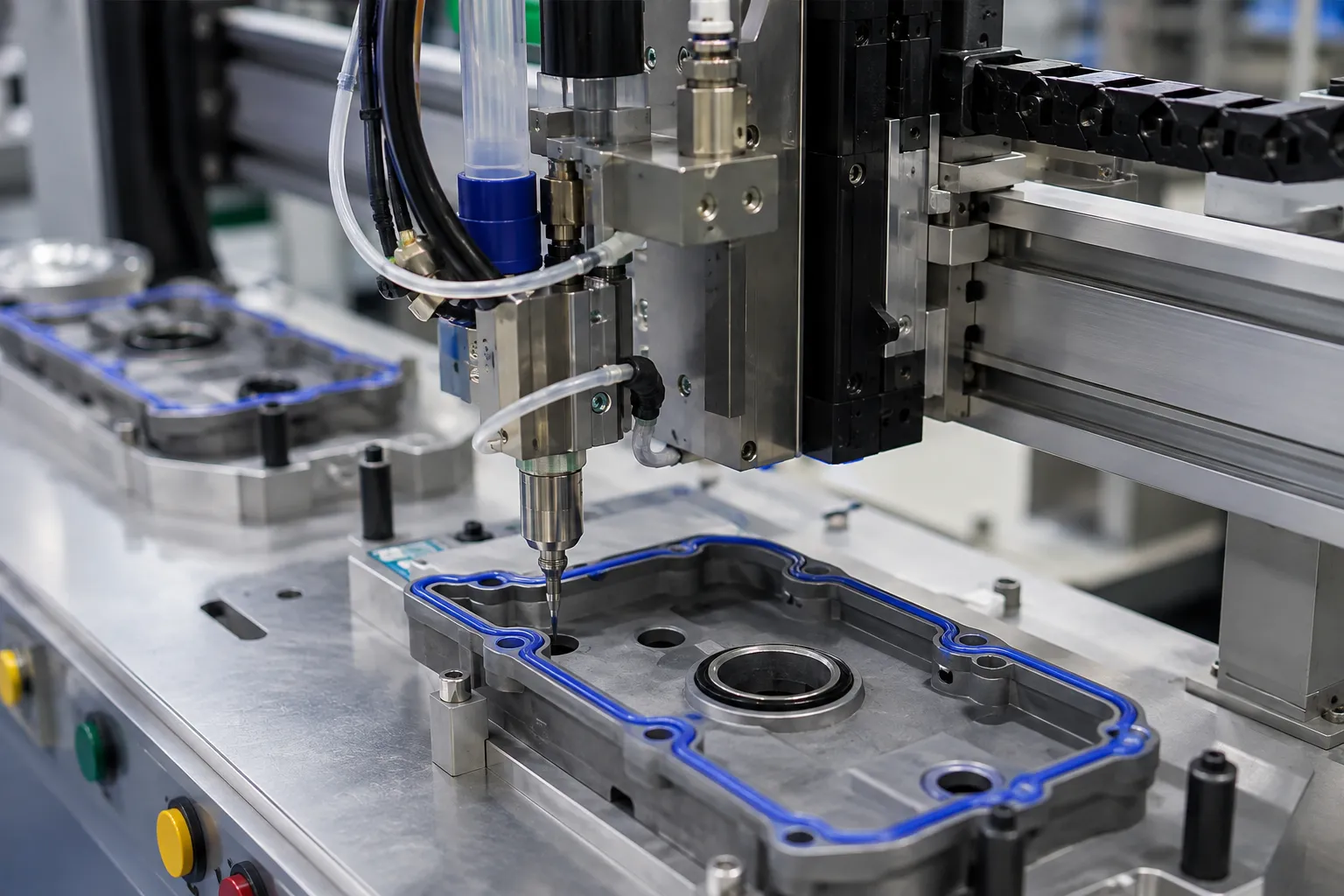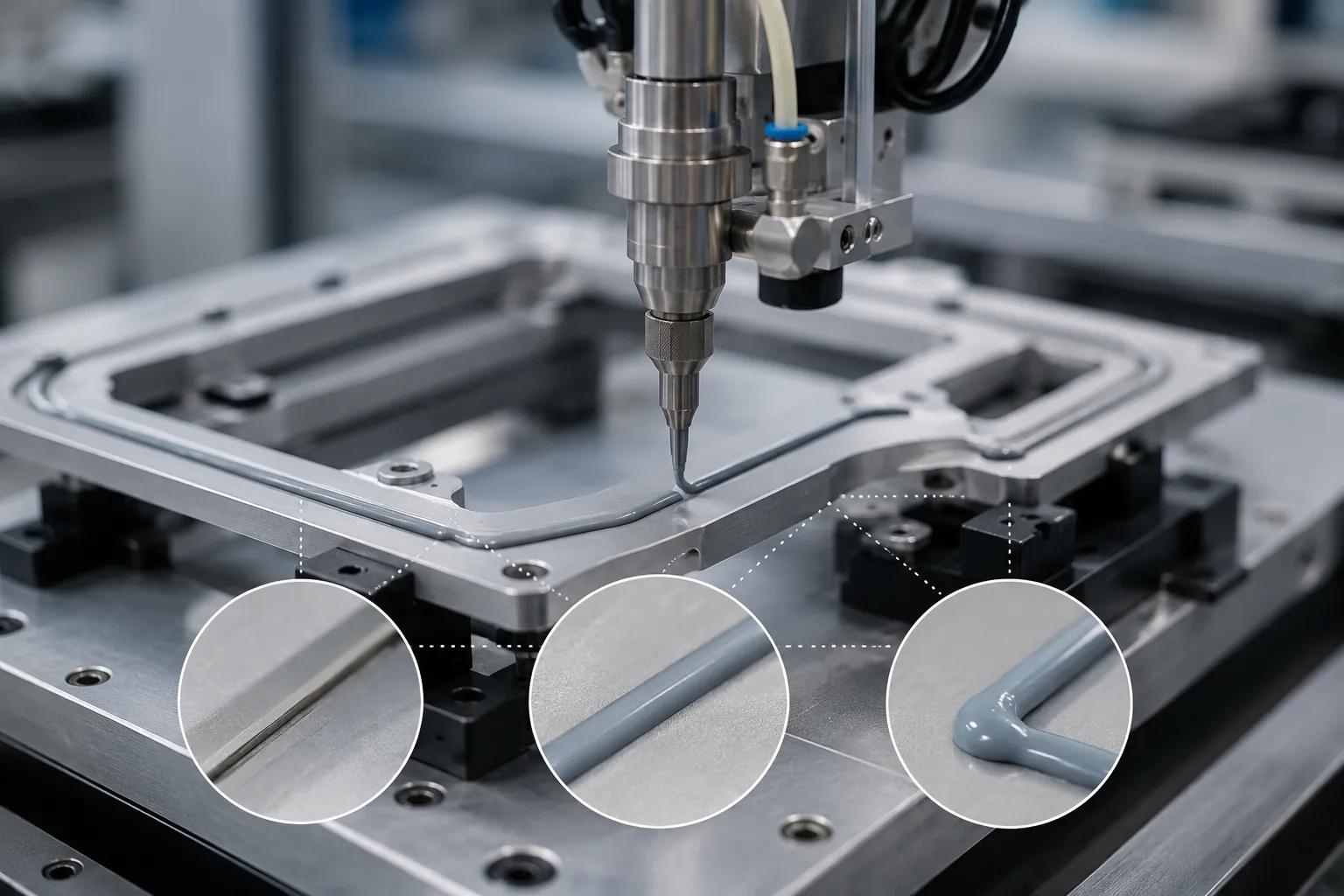



Dispensing system plays a critical role in modern manufacturing by ensuring precise material dispensing, improving product consistency, reducing material waste, and supporting production automation. Across industries such as electronics, automotive, new energy batteries, medical devices, LED, and consumer appliances, dispensing systems handle adhesives, sealants, thermal interface materials (TIM), lubricants, and other industrial fluids with high accuracy. As manufacturers invest in smart factories and automated lines, standalone dispensing machines are evolving into fully integrated automatic glue dispensing systems that work seamlessly with industrial robots, vision inspection, conveyors, and manufacturing execution systems (MES). AMC as we explore what a dispensing system is, its core components, the most common types, their applications, and the key factors to consider when choosing the right solution for long-term production efficiency.
1. What is a Dispensing System?
Many manufacturers assume a dispensing machine and a dispensing system are the same, but they are two different concepts. A dispensing machine generally refers to an individual glue-application unit, while a dispensing system is a complete integrated solution that automates the entire material-dispensing process. A complete glue dispensing system is far more than the robot itself. It typically integrates a material-supply pump, dispensing valve, motion platform, controller, tubing, dispensing needles, positioning sensors, vision cameras, and pressure control units, all working together to deliver material accurately to predefined locations while keeping flow, pressure, and repeatability stable.
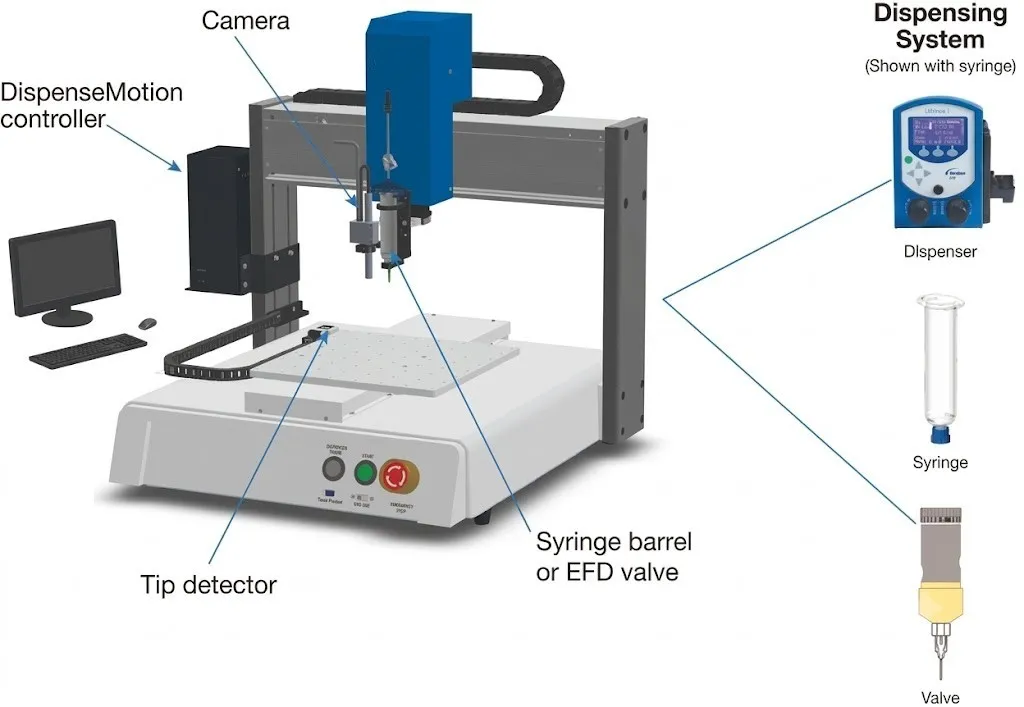
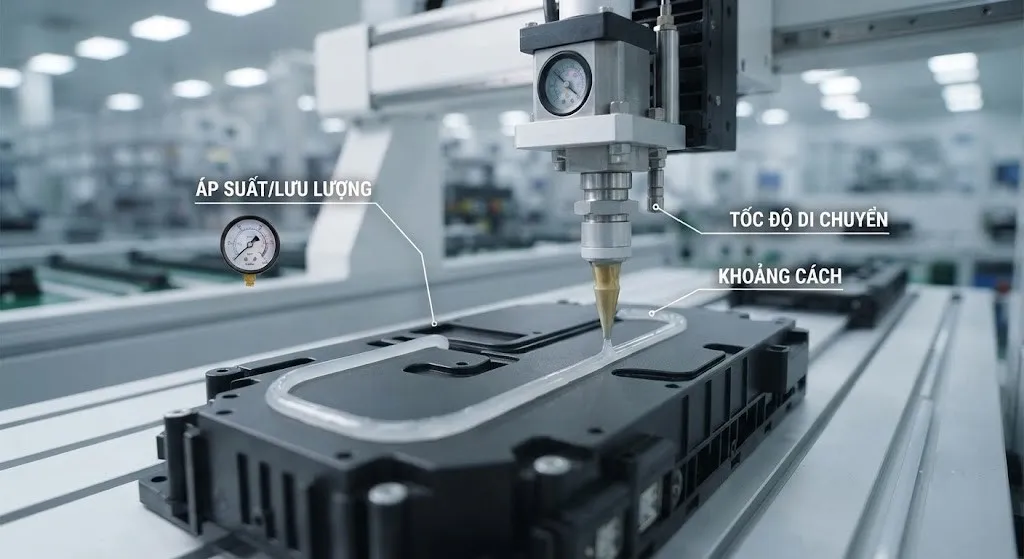
These systems process a wide range of materials, including silicone, epoxy, UV-curable adhesives, polyurethane, TIM, lubricating grease, sealants, potting compounds, and two-component (AB) adhesives. By precisely controlling dispensing volume, pressure, path, and speed, an automatic glue dispensing system produces highly consistent dots and bead patterns while minimizing air bubbles, stringing, overflow, and waste. Because it integrates with industrial robots, conveyors, CCD vision cameras, laser positioning, and factory software, the dispensing system has become a core building block of Industry 4.0. For companies aiming to raise quality while lowering costs, it is less an equipment upgrade than a strategic investment in efficiency and long-term competitiveness.
2. Common types of Dispensing Systems
Because requirements vary widely, no single dispensing system fits every application. The right choice depends on production volume, product size, accuracy, material properties, and automation level.
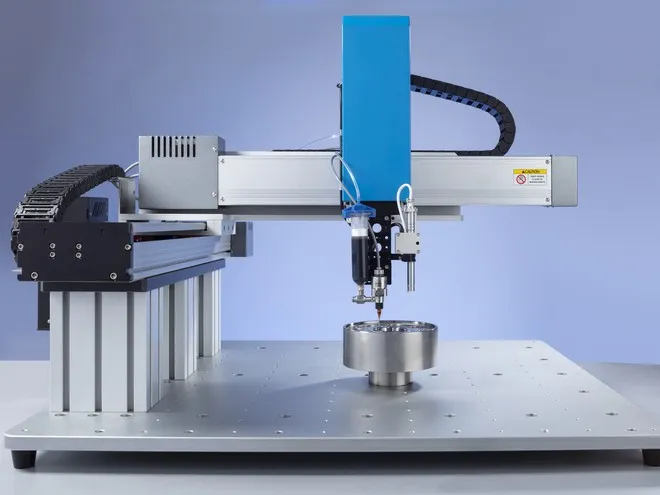
2.1. Desktop Dispensing System
Desktop systems are among the most widely used solutions for small and medium manufacturers, R&D labs, and lines that switch products often. They use an X-Y-Z motion platform driven by servo or stepper motors, with paths, speed, volume, and coordinates programmed through an intuitive controller. Compared with manual work, a desktop dispensing machine delivers far better repeatability, ensuring every dot or bead is consistent while reducing operator error and waste. Compact and affordable, these systems suit silicone, epoxy, UV adhesives, solder paste, and TIM on PCBs, LED modules, cameras, sensors, and connectors, making an ideal entry-level glue dispensing machine for early automation.
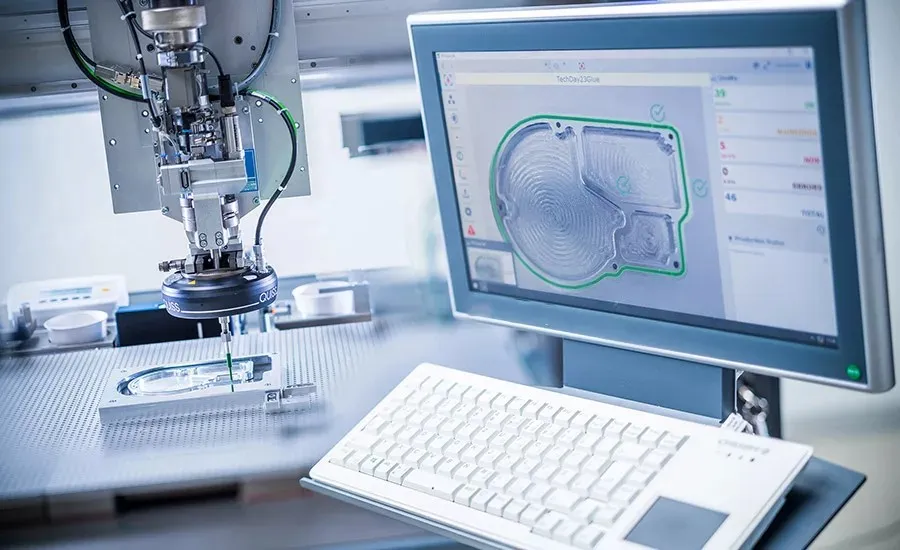
2.2. Gantry Dispensing System
For larger workpieces or longer paths, a gantry system is more suitable. Its rigid bridge-style structure lets the head cover a much larger area while holding high accuracy across the full travel range. A gantry dispensing system is common in battery modules, automotive components, display panels, electrical cabinets, household appliances, and large PCB assemblies. A key advantage is scalability: it integrates easily with CCD vision, laser positioning, automatic calibration, barcode readers, and industrial robots, and its robust frame supports stable operation at high speed.
2.3. Inline Dispensing System
For high-volume production, an inline system offers the highest level of automation. Built directly into an automated line, it lets products move along conveyors and complete dispensing without manual handling, raising throughput. Modern inline dispensing systems add vision alignment, path correction, needle cleaning, glue-level and pressure monitoring, barcode traceability, and real-time MES communication, helping maintain consistent quality, shorten cycle time, cut downtime, and improve overall equipment effectiveness (OEE). As smart factories evolve, automatic glue dispensing systems are becoming standard in continuous, quality-critical production.
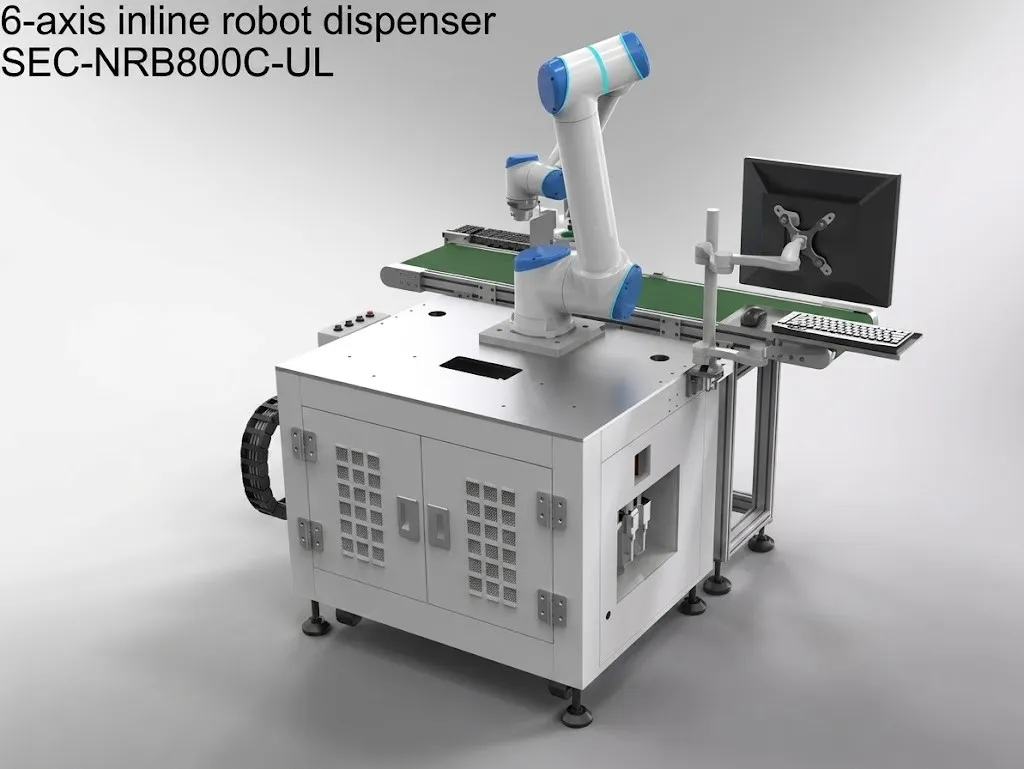
Inline Dispensing System hiện được sử dụng phổ biến trong các dây chuyền SMT, sản xuất PCB, module LED, linh kiện điện tử, ô tô và pin năng lượng mới.
2.4. Two-component Dispensing System
Many applications use two-component materials such as epoxy, polyurethane, or silicone that must be mixed at an exact ratio to achieve proper curing, bond strength, and reliability. A two-component dispensing system automatically meters, mixes, and dispenses both parts in one process using two separate feed lines and a static or dynamic mixer, eliminating manual mixing errors. Precise ratio control improves quality, reduces waste, and lowers defect risk. These systems are widely used in EV battery manufacturing, automotive electronics, power modules, structural bonding, and potting where strength and durability matter.
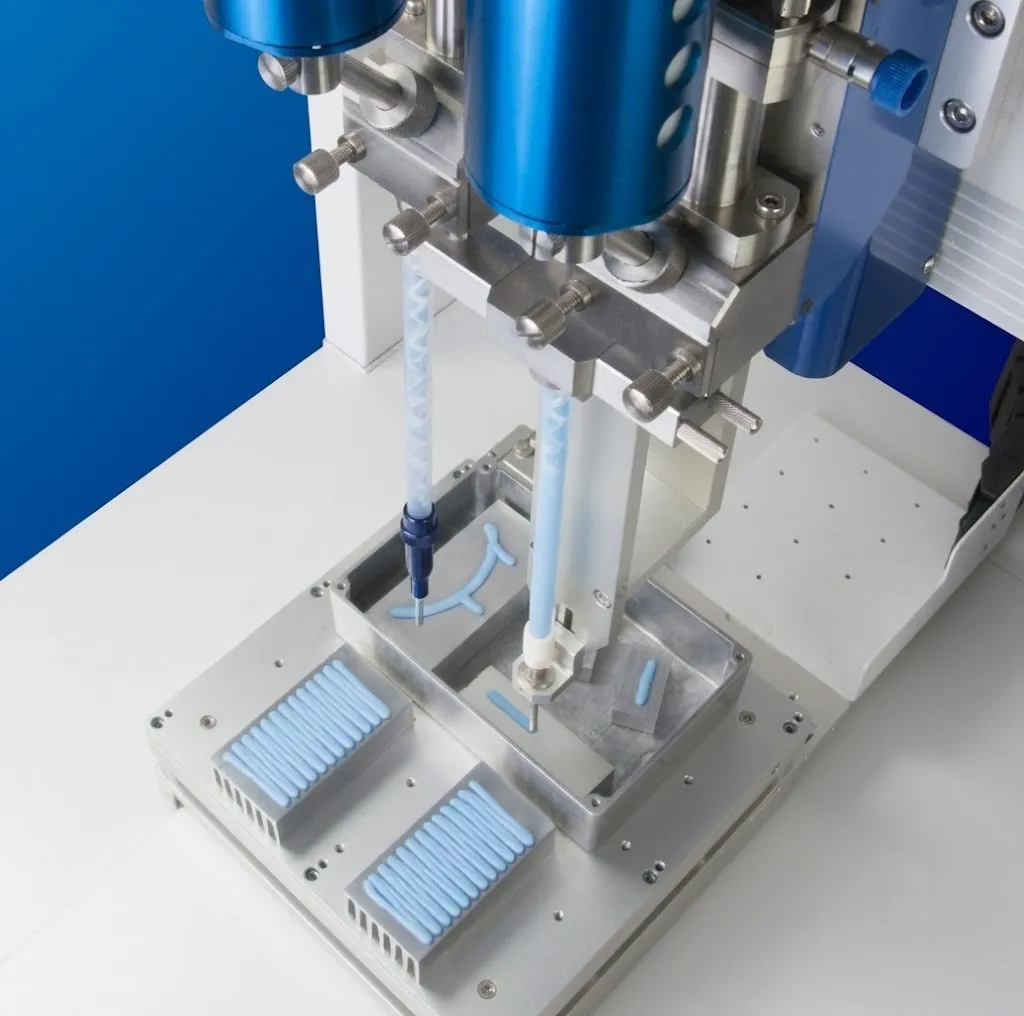
Precise ratio control improves quality, reduces waste, and lowers defect risk. These systems are widely used in EV battery manufacturing, automotive electronics, power modules, structural bonding, and potting where strength and durability matter.
2.5. Customized Dispensing System
In addition to standard configurations, an increasing number of manufacturers are adopting customized dispensing systems designed specifically for their production processes. Rather than relying on a fixed machine configuration, businesses can integrate motion robots, dispensing pumps, dispensing valves, CCD vision cameras, weighing and inspection systems, pressure sensors, material heating units, and intelligent control software into a fully customized and synchronized solution.
For example, electric vehicle (EV) battery production lines often combine high-pressure piston pumps with material heating systems to dispense highly viscous thermal interface materials (TIM) consistently and efficiently. In contrast, PCB assembly lines typically utilize progressive cavity pumps together with machine vision systems to ensure that every adhesive dot is accurately positioned and precisely controlled in size. For two-component adhesives such as epoxy AB or polyurethane, the system can be equipped with an automatic metering and mixing unit to maintain a stable mixing ratio throughout the entire production process. This high level of customization enables a Dispensing System to accommodate a wide variety of materials, product designs, and manufacturing capacities while providing the flexibility to expand or upgrade production lines in the future without replacing the entire system. As a result, customized dispensing solutions have become an important trend among leading automation equipment manufacturers worldwide, helping businesses maximize investment efficiency, improve production flexibility, and adapt quickly to evolving manufacturing requirements.
3. Key Criteria for Choosing the Right Dispensing System
Selecting a dispensing system involves far more than comparing prices. The ideal solution should match the material, technical requirements, output, and future expansion plans. Choosing well from the start improves quality, lowers maintenance cost, and maximizes return over the equipment's service life.
Material properties
The first and most important factor is the material itself. Every adhesive differs in viscosity, filler content, curing behavior, abrasiveness, and temperature sensitivity, and these dictate the feed technology. High-viscosity silicone, TIM, or heavily filled adhesives generally need piston pumps for stable pressure, while precise low-volume dispensing suits progressive cavity pumps for consistent output. For epoxy AB, polyurethane, or two-part silicone, a 2K dispensing system keeps the mix ratio accurate and reduces waste from incorrect mixing.
Dispensing accuracy and production capacity
PCBs, semiconductor packages, LED modules, optical devices, and camera modules often need very small volumes with excellent repeatability, where valve, pump, motion, and needle stability matter more than raw speed. High-volume plants instead prioritize efficiency, and an inline dispensing system with conveyors, robotic handling, and automatic inspection can shorten cycle time without sacrificing precision.
System integration and future scalability
A modern dispensing system should connect with robots, vision inspection, barcode scanners, MES, conveyors, and laser positioning rather than run in isolation, enabling centralized control and traceability. A modular architecture lets you upgrade pumps, valves, motion platforms, or software as needs grow, protecting long-term investment.
Maintenance and technical support
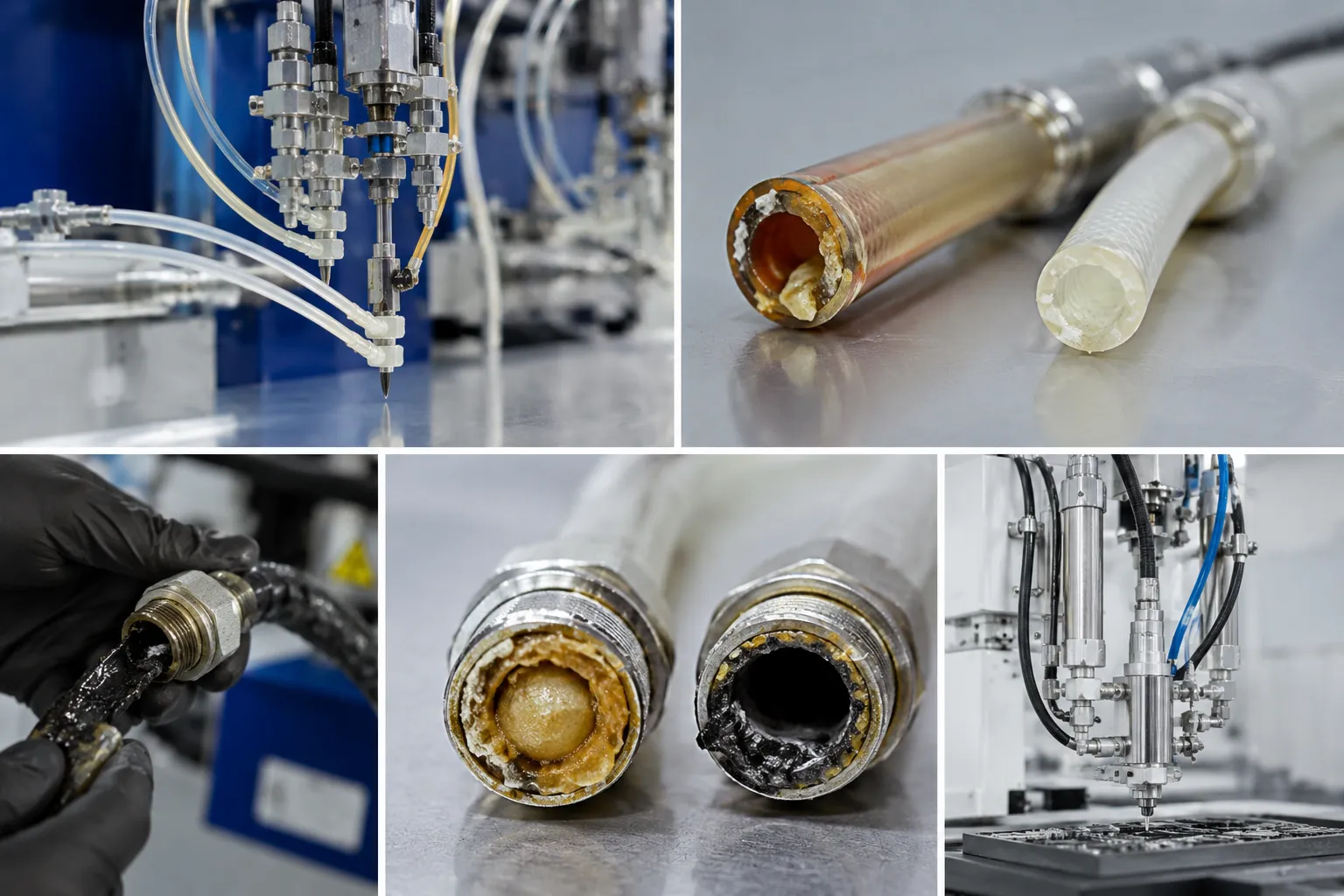
A well-designed glue dispensing system should allow quick replacement of wear parts such as valves, seals, pistons, tubing, filters, and needles to minimize downtime. Working with an experienced supplier also means faster troubleshooting, easier spare parts, and professional process optimization, which for continuous lines can be as valuable as the equipment itself.
The dispensing system has become one of the core technologies behind modern automated manufacturing, delivering precise metering, stable performance, and smooth integration with automated lines to improve quality, cut material consumption, raise productivity, and increase consistency. Because every process has unique requirements, the right dispensing system should be chosen based on material properties, accuracy, production volume, automation level, and future scalability rather than price alone. With extensive experience in industrial dispensing, AMC provides complete solutions ranging from dispensing machines, automatic glue dispensing equipment, pumps, and valves to fully customized dispensing systems for electronics, automotive, new energy batteries, LED, medical devices, and industrial automation. By understanding each customer's process and material characteristics, AMC helps build efficient, reliable, and scalable solutions for sustainable growth. Contact AMC to find the right dispensing system for your application.